///
Building a Custom FPGA Server for Advanced Signal Discrimination
This project focuses on utilizing the FPGA platform for neutron signal discrimination, enabling detection and differentiation of neutron events from noise. The methodology revolves around leveraging a custom data acquisition (DAQ) server, combined with advanced signal processing techniques, to achieve accuracy and efficiency.
////
Project Overview
Neutron Signal Discrimination Process
The heart of this project lies in processing neutron signals to filter out noise and accurately identify neutron events. Below are the core steps and methodologies:
- Data Acquisition:
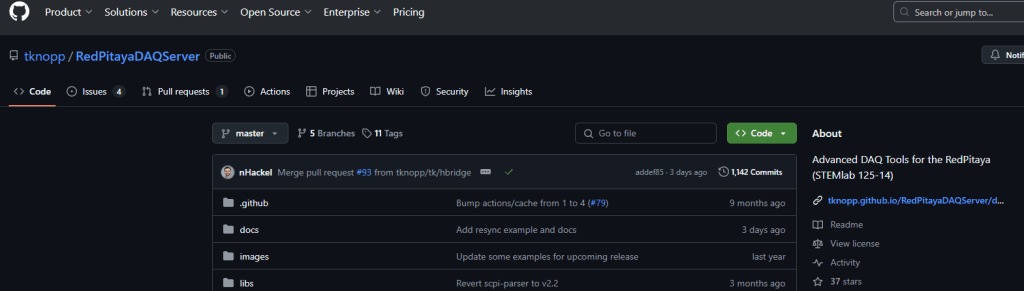
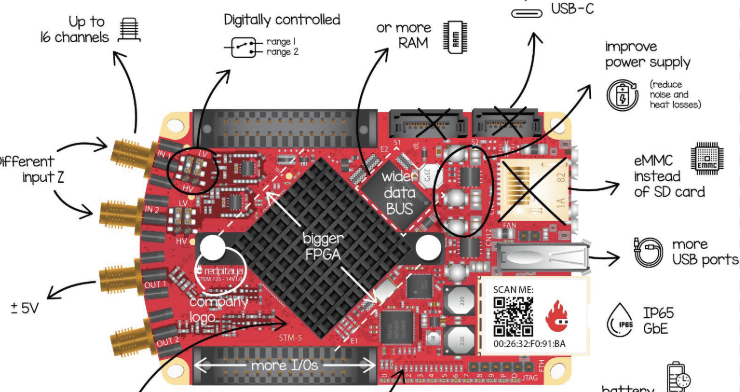
- The Red Pitaya captures raw signal data via its high-speed ADC channels, operating at a sampling rate of 100 kS/s.
- This data is stored in 128MB buffer,
- Than streamed over Ethernet for further processing.
- Preprocessing:
- A Butterworth low-pass filter is applied to the raw signals to remove high-frequency noise.
- Baseline correction is performed by subtracting the average value of the initial signal samples.
- Background Subtraction and Adaptive Thresholding:
- The system continuously calculates the background noise level and updates an adaptive threshold based on 5 standard deviations above the background mean.
- This threshold ensures that only significant events, likely to be neutron signals, are considered for further analysis.
- Signal Analysis and Discrimination:
- A pulse detection algorithm identifies signal regions that exceed the threshold and analyzes them within a fixed window.
- Each detected pulse undergoes pulse shape discrimination (PSD) by calculating the ratio of fast to total pulse components. Events with PSD ratios below a calibrated threshold are classified as neutron events.
- Event Logging and Monitoring:
- Identified neutron events are timestamped and logged in a CSV file for further analysis.
- The system updates and displays counts per second (CPS) in real-time, providing immediate feedback on neutron activity.
Performance Metrics
The system’s performance is measured as follows:
- Sample Rate: The system captures data at a stable rate of 100 kS/s, ensuring temporal resolution for neutron detection. Adjusting decimation factor the sampling rate can increase to 125 000 000 samples per second.
- Processing Speed: The implemented algorithms operate efficiently, enabling real-time analysis of incoming data.
- Event Detection: The system reliably discriminates neutron signals from noise, with results logged for accuracy validation.
/////
CODE
using Pkg
Pkg.activate("/home/pi/.julia/environments/v1.9")  # Replace with your Julia environment path

using RedPitayaDAQServer
using CSV
using DataFrames
using DSP          # For signal processing functions
using Statistics   # For statistical functions like mean, std
using Dates        # For timestamping
# using Plots       # Uncomment if you wish to add visualization (feature 14)

# Set the Red Pitaya IP and port 5025
rp = RedPitaya("rp-f0ac8a.local", 5025)

# Set server in CONFIGURATION mode to prepare signal acquisition
serverMode!(rp, CONFIGURATION)

# Set decimation to 1250 for a sampling rate of 100 kS/s
decimation!(rp, 1250)  # 125 MS/s / 1250 = 100 kS/s

# Set number of samples per period and frame
samples_per_period = 16384  # Adjust if needed
periods_per_frame = 1       # For continuous acquisition

samplesPerPeriod!(rp, samples_per_period)
periodsPerFrame!(rp, periods_per_frame)
triggerMode!(rp, INTERNAL)

# Start acquisition
serverMode!(rp, ACQUISITION)
masterTrigger!(rp, true)

# Initialize counters
global samples_received = 0
global frames_received = 0
global neutron_events_count = 0
global neutron_events_in_last_second = 0
global last_cps_update_time = 0.0

# Initialize background level for adaptive thresholding (feature 10) and background subtraction (feature 9)
global background_level = 0.0
global noise_std = 0.0

# Function to detect and discriminate neutron events
function isNeutronEvent(signal, sampling_rate)
    # Ensure the signal is a 1D array
    signal = vec(signal)

    # Signal Smoothing and Noise Reduction (Feature 4)
    # Noise filtering using a low-pass filter
    cutoff_freq = 40_000      # 40 kHz cutoff frequency

    # Normalize cutoff frequency
    nyquist_freq = sampling_rate / 2
    normalized_cutoff = cutoff_freq / nyquist_freq

    # Ensure normalized_cutoff is less than 1
    if normalized_cutoff >= 1.0
        error("Normalized cutoff frequency must be less than 1")
    end

    # Design a Butterworth low-pass filter
    filter_order = 5
    butter_filter = digitalfilter(Lowpass(normalized_cutoff), Butterworth(filter_order))

    # Apply the filter
    filtered_signal = filtfilt(butter_filter, signal)

    # Baseline correction
    baseline = mean(filtered_signal[1:10000])  # Use first 10000 samples
    adjusted_signal = filtered_signal .- baseline

    # Background Radiation Subtraction (Feature 9)
    adjusted_signal .= adjusted_signal .- background_level

    # Adaptive Thresholding (Feature 10)
    # Update noise standard deviation
    global noise_std = std(adjusted_signal[1:10000])  # Use first 10000 samples
    pulse_threshold = background_level + 5 * noise_std  # Threshold set to 5 sigma above background

    # Detect pulses using custom peak detection
    # Identify indices where the signal crosses the threshold from below
    above_threshold = adjusted_signal .> pulse_threshold
    crossing_indices = findall(diff(above_threshold) .== 1) .+ 1  # Indices where signal rises above threshold

    # Initialize counter
    neutron_events_detected = 0

    # Analyze pulses
    for idx in crossing_indices
        # Define a window around the crossing point for pulse analysis
        window_size = 200  # Adjust based on expected pulse width
        start_idx = idx
        end_idx = min(idx + window_size - 1, length(adjusted_signal))
        pulse = adjusted_signal[start_idx:end_idx]

        # Check if pulse peak is above threshold
        pulse_amplitude = maximum(pulse)
        if pulse_amplitude < pulse_threshold
            continue  # Skip pulses that do not have a peak above the threshold
        end

        # Pulse Shape Discrimination (PSD) (Feature 1)
        fast_window_samples = min(50, length(pulse))  # Number of samples for fast component
        fast_component = sum(pulse[1:fast_window_samples])
        total_component = sum(pulse)
        psd_ratio = fast_component / total_component

        # Set PSD ratio threshold based on calibration
        psd_threshold = 0.3  # Adjust based on calibration

        # Decision logic based on PSD
        if psd_ratio < psd_threshold
            neutron_events_detected += 1

            # Event Logging and Time Stamping (Feature 12)
            event_time = now()
            # Log event data
            open("events_log.csv", "a") do io
                CSV.write(io, DataFrame(timestamp=Dates.format(event_time, "HH:MM:SS.sss"),
                                        psd_ratio=psd_ratio),
                          writeheader=false)
            end

            # For Visualization (Feature 14)
            # Uncomment and adjust the following lines if you wish to store pulse data for plotting
            # open("pulse_data.csv", "a") do io
            #     CSV.write(io, DataFrame(time=(start_idx:end_idx)/sampling_rate, amplitude=pulse), writeheader=false)
            # end
            # Continue processing other pulses
        end
    end

    return neutron_events_detected
end

# Track time
start_time = time()
global last_cps_update_time = start_time

# Create CSV file for CPS data
csv_file = "/home/pi/Desktop/Desktop/Neutron/rp_test/test.csv"
df = DataFrame(timestamp=Float64[], cps=Float64[])
CSV.write(csv_file, df)

# Sampling rate
sampling_rate = 125_000_000 / 1250  # 100 kS/s

# Main loop
while true
    fr = currentFrame(rp)
    uCurrentPeriod = readFrames(rp, fr, 1)

    # Ensure the signal is in the correct format
    signal = uCurrentPeriod[:]

    # Update counters
    global samples_received += samples_per_period * periods_per_frame
    global frames_received += 1

    # Update background level for background subtraction (Feature 9)
    # Assuming neutron events are rare, we can update background level continuously
    global background_level = mean(signal[1:10000])  # Use first 10000 samples

    # Check for neutron events
    neutron_events_detected = isNeutronEvent(signal, sampling_rate)

    # Update counters
    global neutron_events_count += neutron_events_detected
    global neutron_events_in_last_second += neutron_events_detected

    # Time calculations
    elapsed_time = time() - start_time
    samples_per_second = samples_received / elapsed_time
    frames_per_second = frames_received / elapsed_time

    # Update CPS every second
    current_time = time()
    if current_time - last_cps_update_time >= 1.0
        cps = neutron_events_in_last_second / (current_time - last_cps_update_time)

        # Display data
        println("Samples per second: $samples_per_second")
        println("Frames per second: $frames_per_second")
        println("Neutron Counts Per Second (CPS): $cps")

        # Write to CSV with timestamp (Feature 12)
        open(csv_file, "a") do io
            CSV.write(io, DataFrame(timestamp=current_time - start_time, cps=cps), writeheader=false)
        end

        # Reset counter
        global neutron_events_in_last_second = 0
        global last_cps_update_time = current_time
    end

    # Optional sleep to prevent high CPU usage
    # sleep(0.01)
end

# Stop acquisition (this part will not be reached in the infinite loop)
masterTrigger!(rp, false)
serverMode!(rp, CONFIGURATION)
 DOMEN SNUDERL